

Internationalisation · MESA
An opportunity needs to be financially viable and within the capacity to deliver.
MESA International structures the assessment of opportunities, connects counterparties, economics, resources and risks, and submits decisions to the authorised people.
Discuss an opportunityThe role of MESA
Between a relationship and a commitment lies a decision.
A conversation opens possibilities. To move forward, we need to know who is on the other side, what is being proposed, how the transaction is viable and who can authorise each commitment.
Throughout the journey.
MESA supports preparation, execution and the development of subsequent business. It organises information and submits issues to the designated decision-makers within the contracted mandate.
In both directions.
Brazilian capacity seeking a market. International demand seeking supply and partners in Brazil. Each opportunity retains its own economics, conditions and responsible parties.
From opportunity to decision
Qualify. Assess. Submit. Decide.
- 01
Qualify
Counterparty, need, product and fit with the project.
- 02
Assess
Prices, costs, resources, risks, documents and execution capacity.
- 03
Submit for a decision
Economics, gaps, limits and recommendation presented to the authorised people.
- 04
Decide
Next steps recorded, with conditions, limits and responsible parties.
- Proceed
- Adjust
- Do not proceed
Negotiating a term does not automatically authorise contracting or shipment. Each commitment requires the corresponding approval.
What the analysis covers
A dossier for reviewing the transaction before making the commitment.
- Counterparty and purpose
- Who is operating, what they need and what information supports the opportunity.
- Economics and resources
- Assumptions, revenue, costs, timing, payments, receipts and cash requirements.
- Capacity and risks
- Offering, fulfilment, interfaces, dependencies and matters still awaiting evidence.
- Mandate and approval authority
- Who negotiates, within what limits, and who can approve and formalise commitments.
- Rights and obligations
- Who delivers, receives and is accountable; how costs, risks and results are allocated.
- Next step
- Decision, conditions for proceeding, outstanding items and responsible parties recorded.



Workstreams within the mandate
The same discipline for different opportunities.
- Trade, products and supply.
- Markets, distributors and partners.
- Payment terms, resources and investment opportunities.
- Projects, assets, industry, logistics and partnerships.
The scope of the work and the specialists required are defined for each project.
See how the structure is organisedFor clarity
Frequently asked questions.
Does MESA come after the first vessel?
MESA operates across the journey. It can support the project from preparation and remains connected to execution and continuity decisions.
Does Taylor make decisions on the company's behalf?
The company retains its approval authority. Taylor prepares information, recommendations and coordination within the mandate. Authorised people decide and formalise the commitments for which they are responsible.
Does a commercial introduction mean a transaction is approved?
An introduction begins the assessment. Counterparty, conditions, resources, capacity and obligations must be verified before the corresponding approval.
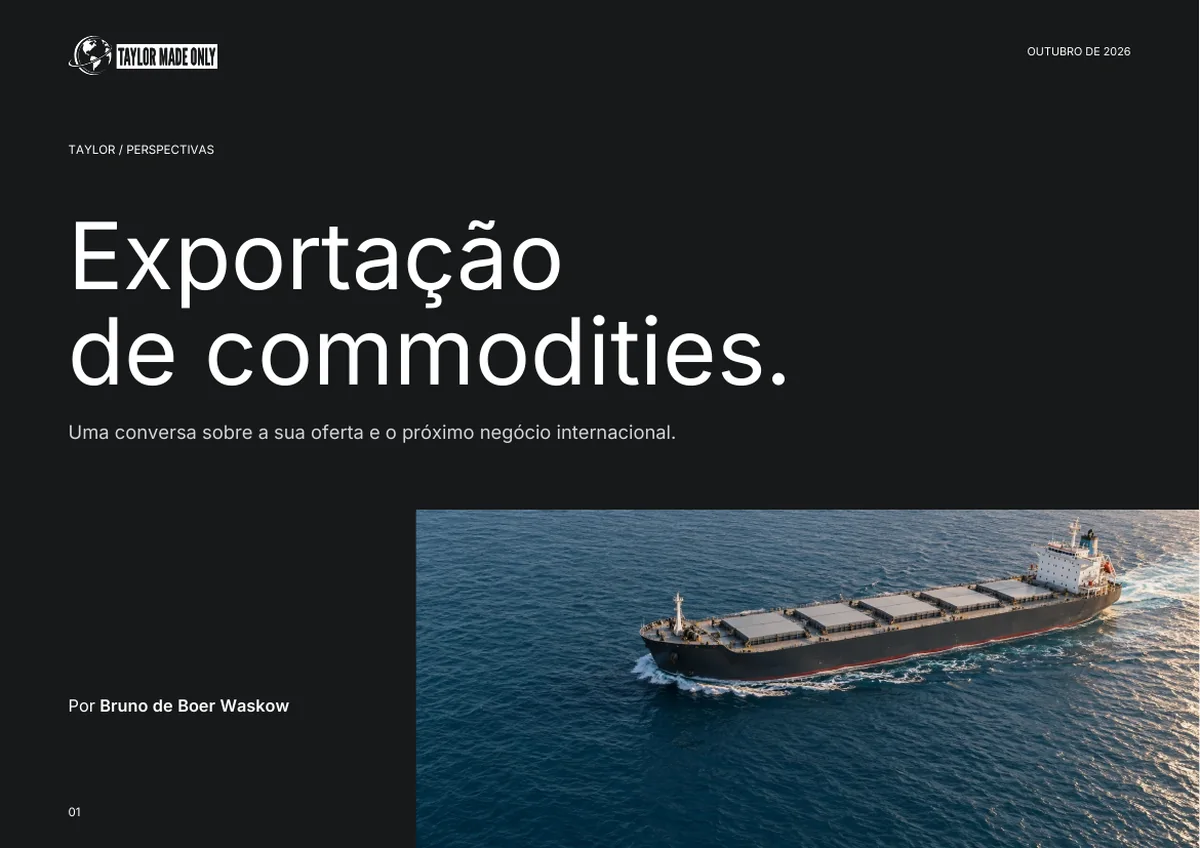
Preparing the next business opportunity
Your offer needs to support the next conversation.
Product, availability, references and fulfilment terms brought together in a report for commodity producers, originators and traders.
Commodity exports


A conversation about your business
Which opportunity needs closer examination?
Bring the objective, counterparty, known conditions and what still needs to be verified. That is the starting point for the analysis.
Discuss an opportunity